An individual problem, or a process problem?
This is the question sales figures never settle. A manager who sends the whole team to training when the blockage sits with one representative wastes the budget. One who coaches individually when five share the same weakness repeats the same exercise five times without fixing anything.
Shared weakness — a collective issue
Weak discovery across five representatives out of six does not come from the individuals. It comes from what the sales process asks of them, how opportunities reach them, or the habit of presenting before questioning. What gets addressed: the process, group training, and what the manager measures and rewards.
Isolated gap — an individual issue
A representative clearly below their own team's average on a competency their colleagues handle well. This is where individual coaching produces a real effect. What gets addressed: targeted support, field accompaniment, or repositioning into a role that fits the profile better.
The order in which to correct
A late objection is almost always a need that was never identified upstream. Training on objection handling before discovery has been corrected will achieve nothing. The diagnostic indicates where to start.
What you receive — a map, not a ranking
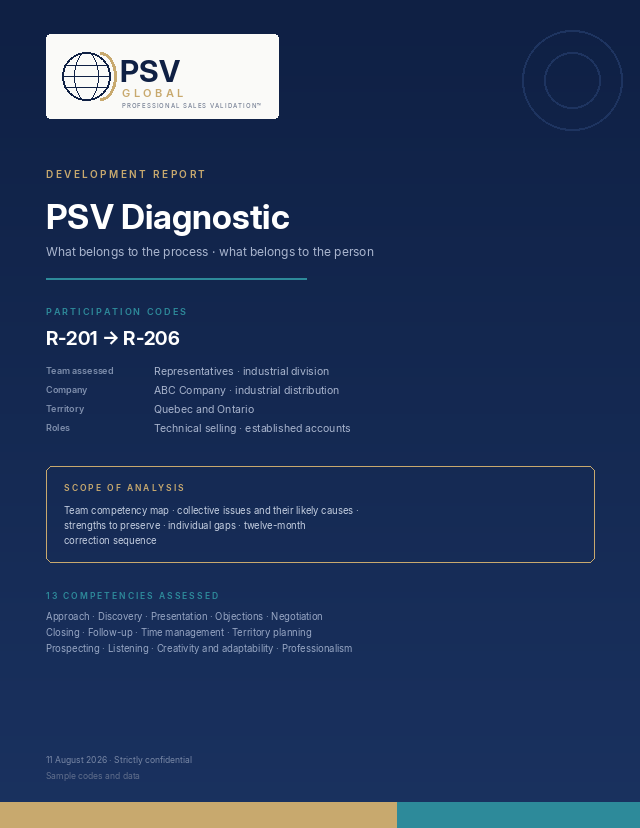
The diagnostic does not rank your representatives from best to worst; you do not need us for that. It reads horizontally: competency by competency, across the whole team. The 13 competencies as rows, your representatives as columns, the team average on the right. Shared weaknesses and collective strengths stand out visually.
Each collective issue is then explained — where it likely comes from, what it reveals about your commercial approach, and where to begin. Individual gaps are listed separately, once shared weaknesses have been removed, along with the gap between each person's self-perception and their results.
A development tool, not a performance review. The diagnostic should not support a disciplinary decision or be placed in an employee file. We recommend sharing the results with each representative: a profile discussed openly achieves more than one kept by management.
When the decision becomes heavier
Keep, coach in depth, reposition or replace. This decision costs more than a hire, and most managers postpone it for want of a clear reading. The full individual analysis — PSV Strategic Performance (295 CAD per representative) — reuses the answers already given: detailed role fit, coachable gaps separated from areas of concern, coaching conditions and a 90-day plan. No new questionnaire is required.
Results alone do not tell the whole story
A salesperson can meet a target while relying on a small number of existing accounts, delaying prospecting or avoiding difficult conversations. Another may miss a target despite strong commercial habits because the territory, product, pricing or market conditions are unfavourable. Revenue matters, but it cannot by itself explain the behaviours behind performance.
Managers often respond with more pressure, generic training or repeated advice. These actions may be appropriate, but only if they address the real issue. PSV adds structure by exploring how the representative reasons through common sales situations and how they perceive their own capabilities.